How to Build an Online Presence
Everyone has something worth sharing. Whether you love sports, photography, technology, gaming, gardening, crafting, collecting, or documenting everyday experiences, the internet creates opportunities to connect with people who share those interests.
Building an online presence does not mean you need to become an influencer or start a business. It can begin with a social profile, a few helpful posts, a personal portfolio, or a place to collect photos, stories, and recommendations. As your interests evolve, your presence can grow with them.
This guide explains the basic steps, what choices you have, and how Hubb Serve can help you explore, share, build, and—if you choose—earn.
1. Start with an interest and a purpose
First, decide what you want to share and why. Your topic can be broad, such as outdoor activities, or focused, such as coaching tips for beginner baseball players. You do not have to pick a permanent niche on day one; choose a starting point that you can enjoy discussing over time.
·Share experiences, progress, photos, or accomplishments.
·Teach a skill, review products, or answer common questions.
·Build a portfolio, support a club or cause, or promote a small business.
·Meet people who enjoy the same interests—or simply keep an organized online record.
Try writing a one-sentence purpose: “I share beginner-friendly gardening ideas with families learning to grow their own food.” This helps you decide what to create and where to publish it.
Hubb Serve connection:Browse interest-based Hubbs to explore ideas and discover ways others organize information around the things they enjoy.
2. Know who you want to reach
Think about the people most likely to value your content. Are they beginners, experienced enthusiasts, parents, local community members, hobbyists, or potential customers? Knowing your audience helps you pick the right topics, tone, and platforms.
Instead of trying to appeal to everyone, consider one or two groups. For example, a youth-sports parent could share practical equipment checklists for other families, while a maker could publish project photos and tips for fellow hobbyists.
Ask yourself: What questions do these people have? What would help them? What would make them want to return or share your page?
3. Choose where to build your presence
You do not need a standalone website to get started. Different platforms serve different purposes, and you can combine them over time.
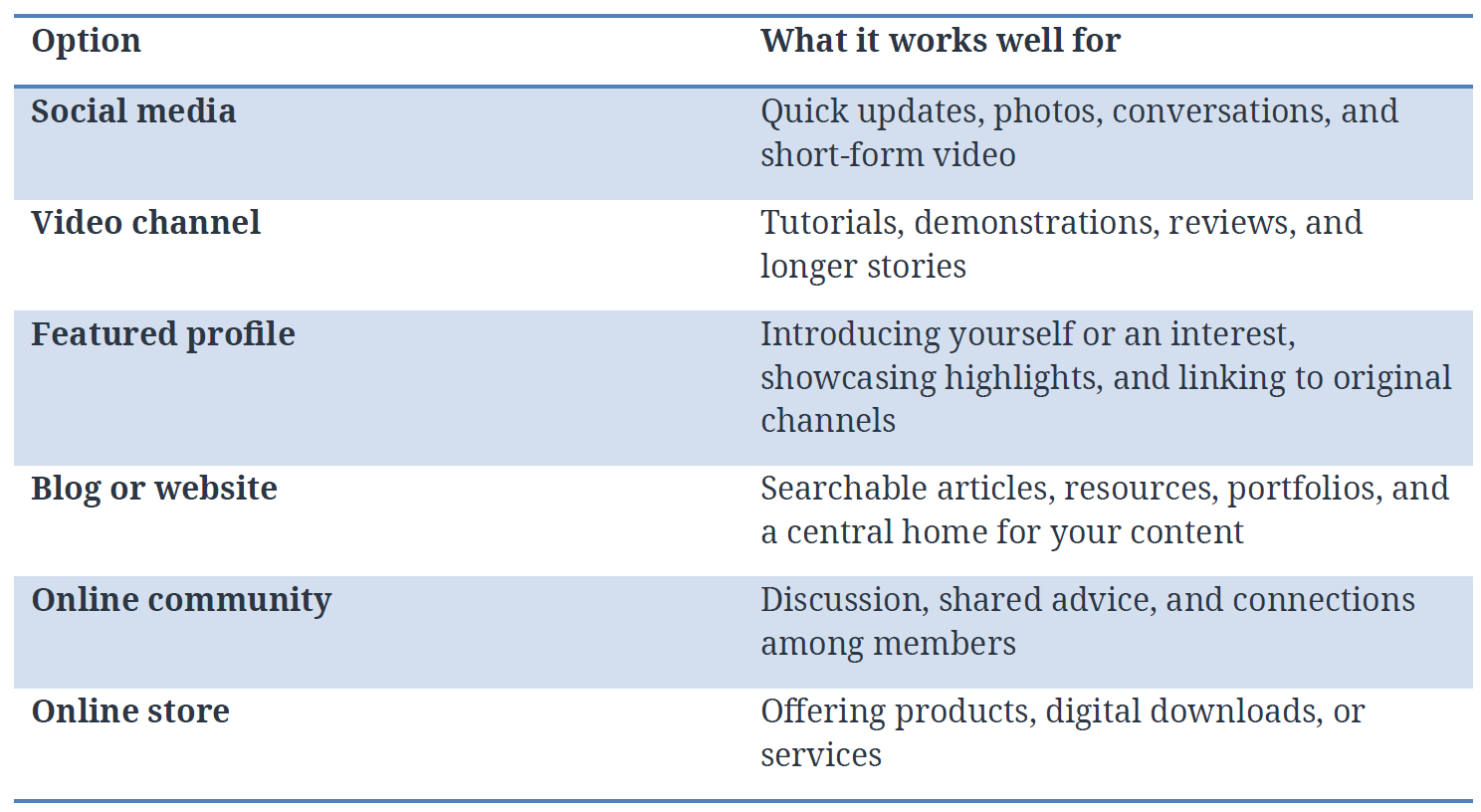
Many people start on one platform and expand later. Social media can help you engage with an audience, while a website or featured page can give people a consistent destination even if social platforms change their feeds or features.
4. Create a clear identity and your first content
Choose a name that people can recognize and use consistently where possible. Write a short description explaining what you share. Add an appropriate image or logo, a few clear links, and a simple way for people to understand what they will find.
Your first content does not need to be perfect. A small collection of useful, authentic posts gives visitors a reason to stay. Consider starting with:
·An introduction: who you are, what you enjoy, and what you plan to share.
·A how-to article, helpful checklist, or answer to a common question.
·Photos or videos that document a project, experience, or skill.
·A thoughtful review, recommendation, or lessons learned.
Choose a realistic publishing rhythm. One useful post every two weeks is better than promising daily updates you cannot maintain. For family or youth-related content, share only information and images you have permission to publish; avoid unnecessary personal details and location information.
Hubb Serve connection: A featured page can introduce your interests and point readers to your original social channels or other published work.
🔎 Looking for something new to explore? Discover hobbies, sports, creative interests, technology, communities, products, and more across Hubb Serve. Find an interest and explore the Hubbs to see what catches your attention and where it takes you.
5. Help people discover your content
Publishing is the beginning; making content understandable and findable helps others discover it. Search engine optimization (SEO) is simply the practice of making pages clearer to search engines and the people using them. You do not need advanced technical knowledge to apply basic principles.
·Give every article or video a specific, descriptive title.
·Use words that readers would naturally search for, without repeating them excessively.
·Organize longer content with useful headings and related links.
·Add meaningful descriptions to images where the platform supports them.
·Share new work with relevant communities without spamming.
·Link your profiles and website so visitors can move between them.
Discovery takes time, and no platform can guarantee reach. Focus on accurate information, useful content, and a consistent experience for visitors.
Hubb Serve connection: Interest-based organization and featured content can give readers another way to encounter your work and find your original channels.
6. Build relationships—not just follower counts
An online audience is more than a number. A small group of engaged readers who trust your recommendations can be more meaningful than a large audience that rarely interacts. Respond respectfully to comments, answer questions, acknowledge contributors, and pay attention to what people find useful.
You can also connect with other creators or groups who share compatible interests. Collaborations, shared projects, and community participation can introduce your content to new people when the partnership is relevant and genuine.
Keep appropriate boundaries: moderate comments, respect copyright, credit sources, obtain permission before featuring people, and disclose commercial relationships when applicable.
Hubb Serve connection: Profiles can help interested readers discover creators and continue following their work through the channels they choose to share.
7. Learn, improve, and grow at your own pace
As you publish more, review what is working. You do not need an elaborate analytics system; start with a few useful signals:
·Which posts people read, watch, save, or share.
·Which questions or topics produce thoughtful engagement.
·Where visitors find your content and what links they follow.
·Whether your publishing routine is sustainable and enjoyable.
Use what you learn to update older articles, improve your descriptions, organize related resources, or try a different format. Growth is rarely linear; the goal is steady improvement, not instant popularity.
When you need more flexibility, you might add a blog, a dedicated website, a newsletter, a portfolio, or a store. Expand only when the extra effort supports your goals.
Hubb Serve connection: As your goals evolve, you can explore ways to build a dedicated content presence or storefront alongside your existing channels.
8. Explore ways to earn, if and when they fit
Making money is optional—not a requirement for building a successful online presence. Some creators eventually explore affiliate links, product recommendations, advertising, sponsorships, digital downloads, memberships, services, or online shops.
Each approach has different costs, eligibility requirements, and responsibilities. For example, affiliate programs typically pay only for qualifying activity and may require clear disclosures. Advertising income often depends on traffic and program approval. A storefront also brings customer service, fulfillment, and tax considerations.
A helpful first principle is to build genuine value and trust before expecting revenue. For a deeper discussion, see Hubb Serve’s companion guide, “From Online Presence to Profit,” covering common monetization methods and how to evaluate them.
Hubb Serve connection: Hubb Serve’s Earn pathway https://hubbserve.com/post/earnonline introduces options related to product promotion, affiliate recommendations, services, and digital content.
Find your path with Hubb Serve
Hubb Serve is built around a simple idea: whatever you are into, there is a Hubb for that. You can choose the level of involvement that makes sense for you.
Explore — Discover interests, ideas, people, and resources through themed Hubbs.
Share — Request to be featured and showcase an interest, achievements, content, or social links.
Build — Explore creating a website, publishing resources, or developing your own online content and store.
Earn — Learn about opportunities to promote products, services, digital content, or affiliate recommendations.
You do not need to do all four. You can explore without publishing, share without running a website, or build an independent presence before considering earnings. Choose what fits your interests and available time.
A simple starter checklist
·Choose an interest and write down why you want to share it.
·Identify one audience and three questions you can help answer.
·Pick one primary platform and complete your basic profile.
·Publish your first three useful pieces of content.
·Connect your relevant profiles and share your work appropriately.
·Review what people respond to, then choose one small improvement.
Your online journey starts with one step
You do not need expensive equipment, a huge following, or an established business to begin. Start with something you care about, create a place to share it, and build from there. Your presence may remain a personal hobby, become a growing community, or open doors you never expected.
Hubb Serve can help you explore the possibilities: discover an interest, share your story, build something of your own, or learn about opportunities to earn. Whatever you are into, there is a Hubb for that.
EXPLORE • SHARE • BUILD • EARN
📌 Ready to take the next step? Want to get a featured profile to showcase your interests and link to your content, or learn about building a more dedicated presence with Hubb Serve. Join Hubb Serve to bring your interests, content, recommendations, and online presence together in one place. Whether you want to share, build, grow, or earn, you can join Hubb Serve and start building your online presence today.