Discover the World of Pokémon: Cards, Games, Collectibles & More
Learn to Play Pokémon: The Ultimate Beginner's Guide to the Pokémon Trading Card Game
Collect the Cards. Build Your Team. Master the Battle. Start Your Pokémon Adventure!
Have you ever opened a pack of Pokémon cards and wondered what you could actually do with them?
Maybe you've collected your favorite Pokémon, traded cards with friends, or admired a shiny holographic card. But did you know those cards are also part of an exciting strategy game?
Welcome to the world of the Pokémon Trading Card Game (TCG), where collecting meets strategy, friendly competition, and fun!
Whether you're a parent learning alongside your child, a brand-new Pokémon fan, or a collector ready to put your cards into action, this guide will help you understand the basics and get started.
What Is the Pokémon Trading Card Game?
The Pokémon Trading Card Game is a two-player strategy game where players become Pokémon Trainers, build teams of Pokémon, and battle against each other using trading cards.
Each player uses a deck containing Pokémon, Trainer, and Energy cards. The goal is to use your Pokémon's abilities and attacks to defeat your opponent's Pokémon and collect Prize cards.
But Pokémon isn't just about winning battles. It's also about learning strategy, making decisions, practicing patience, and having fun.
The best part? You don't need to be an expert to start playing!
1. Get to Know the Three Main Types of Pokémon Cards
Before your first battle, it helps to understand the cards you'll be using.
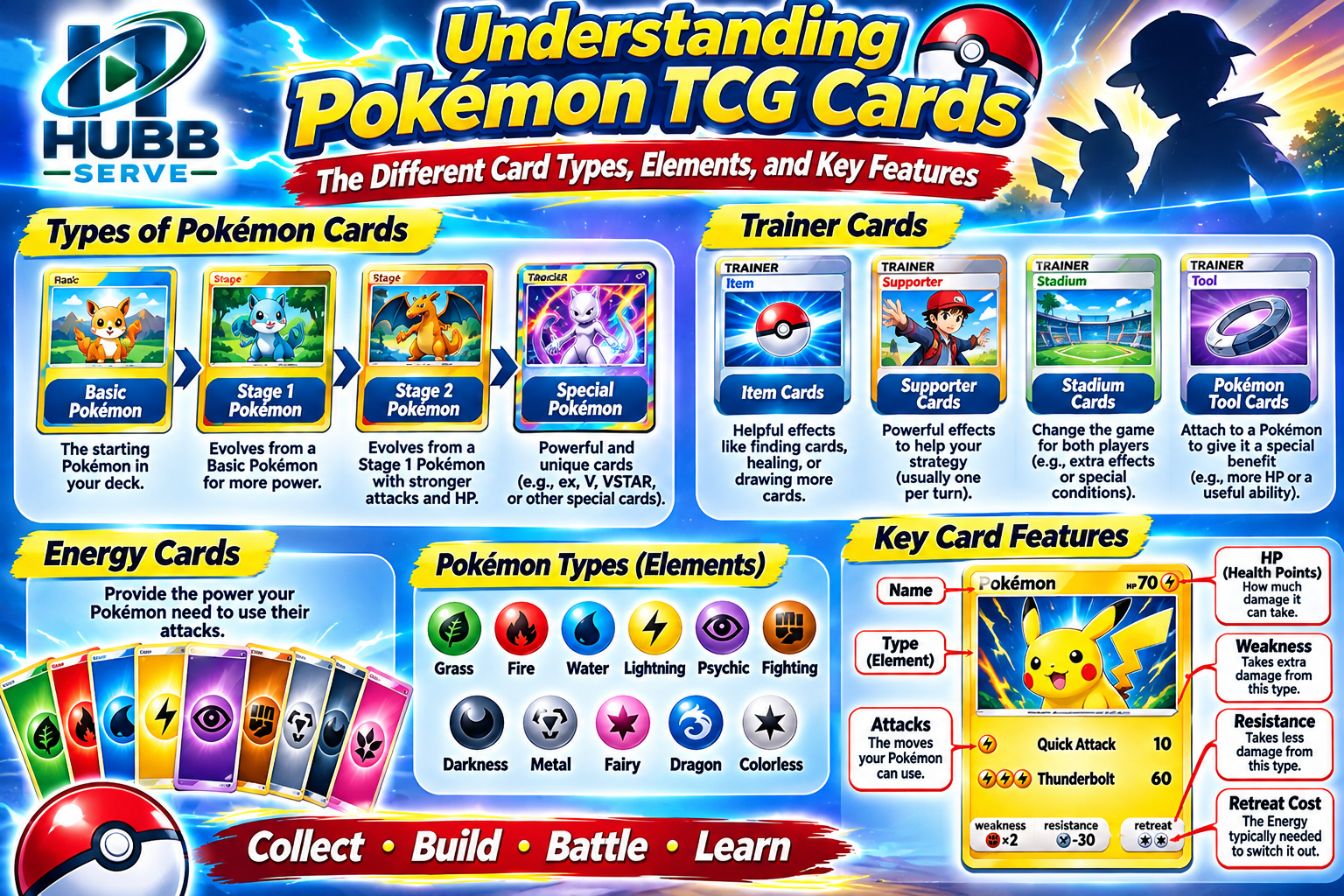
Pokémon Cards – Your Battle Team
Pokémon cards are the heart of the game. Each Pokémon has characteristics that determine how it battles.
Look for:
HP (Hit Points): How much damage your Pokémon can take before being Knocked Out.
Type: Such as Fire, Water, Grass, Lightning, or Psychic.
Attacks: Moves your Pokémon can use during battle.
Energy Requirements: The Energy needed to perform attacks.
Weakness and Resistance: How certain attack types affect your Pokémon.
Retreat Cost: The Energy you typically need to discard to move your Active Pokémon to the Bench.
Pokémon cards also have different evolutionary stages.
Basic Pokémon: Pokémon that can be played directly onto the field.
Stage 1 Pokémon: Evolve from specific Basic Pokémon.
Stage 2 Pokémon: Evolve from specific Stage 1 Pokémon.
Beginner Tip: Start with Basic Pokémon and gradually learn how evolution works.
Energy Cards – Power Your Attacks
Energy cards provide the power your Pokémon need to attack.
Many Pokémon attacks require specific Energy types or amounts. For example, an attack might require one Fire Energy and one additional Energy of any type.
During a normal turn, you can usually attach one Energy card from your hand to one of your Pokémon.
Planning which Pokémon receives Energy is an important part of battle strategy.
Trainer Cards – Your Secret Weapons
Trainer cards help you develop your strategy.
They include:
Item Cards: Provide useful effects, such as searching for Pokémon or drawing cards.
Supporter Cards: Often provide powerful effects, but you can normally play only one per turn.
Stadium Cards: Change aspects of the game for both players.
Pokémon Tool Cards: Attach to Pokémon and provide special benefits.
Beginner Tip: A strong deck needs more than powerful Pokémon. Trainer cards help make your entire strategy work!
2. What Do You Need to Start Playing?
One of the easiest ways to learn Pokémon is with a ready-to-play Battle Deck or beginner learning kit.
For a standard Pokémon TCG game, you'll need:
Two Pokémon decks containing 60 cards each
Damage counters or dice to track damage
A coin or coin-flip die
A playing surface or Pokémon playmat
Markers for special conditions when needed
Two players ready for a friendly battle!
Don't have a deck yet?
A preconstructed Pokémon TCG Battle Deck is an excellent starting point because the cards are already organized into a playable deck.
For families learning together, Pokémon TCG Battle Academy products are another option, often including decks, learning materials, and a gameboard.
Some simplified introductory products use smaller decks and special beginner rules before progressing to the standard game.
3. How to Set Up Your First Pokémon Battle
Now that you've learned about the cards, it's time to prepare your battlefield.
Step 1: Shuffle Your Deck
Each player shuffles their 60-card deck.
Step 2: Draw Seven Cards
Draw seven cards from the top of your deck.
Look for at least one Basic Pokémon.
If you don't have one, reveal your hand, shuffle it back into your deck, and draw seven new cards. Your opponent may receive an additional card draw for each time you repeat this process.
Step 3: Choose Your Active Pokémon
Select one Basic Pokémon from your hand and place it face down in your Active Pokémon position.
This Pokémon will begin the battle.
Step 4: Build Your Bench
Place up to five additional Basic Pokémon face down on your Bench.
These Pokémon are waiting to join the battle.
Step 5: Set Aside Your Prize Cards
Place the top six cards from your deck face down in your Prize card area without looking at them.
Step 6: Decide Who Goes First
Flip a coin. The winner chooses who takes the first turn.
Step 7: Start the Battle!
Both players reveal their Active and Benched Pokémon.
Your Pokémon adventure has officially begun!
4. How Does a Pokémon Turn Work?
During each turn, players make decisions that help strengthen their team and move closer to victory.
Start Your Turn: Draw a Card
At the beginning of your turn, draw one card from your deck.
The player who goes first does not draw a card on their very first turn.
Build Your Team
During your turn, you may take several actions, including:
Play Basic Pokémon: Place additional Basic Pokémon onto your Bench if you have room.
Evolve Your Pokémon: Evolve eligible Pokémon into stronger forms. Normally, a Pokémon cannot evolve on the same turn it was played or on your first turn.
Attach Energy: Attach one Energy card from your hand to one Pokémon during your turn.
Play Trainer Cards: Use Trainer cards to support your strategy, following their instructions and play limits.
Use Abilities: Some Pokémon have Abilities that provide special effects.
Retreat Your Active Pokémon: If permitted, pay its Retreat Cost to move it to your Bench and replace it with another Pokémon.
Attack Your Opponent
When you're ready, your Active Pokémon can use an attack if it meets the attack's requirements.
Follow the instructions on the Pokémon card, calculate damage, and apply any additional effects.
Attacking generally ends your turn.
Important beginner rules:
The first player cannot attack on their first turn.
The first player cannot play a Supporter card on their first turn.
Most Pokémon can use only one attack per turn.
You don't have to attack if you aren't ready.
Then your opponent takes a turn!
5. How Do You Win a Pokémon Battle?
There are three main ways to win a standard Pokémon TCG game.
Collect All Six Prize Cards
When you Knock Out an opponent's Pokémon, you take Prize cards according to that Pokémon's rules.
Most Pokémon give up one Prize card, but some special Pokémon give up two or more.
Collect all your Prize cards to win!
Knock Out Your Opponent's Last Pokémon
If your opponent has no Pokémon remaining in play, you win.
Your Opponent Cannot Draw a Card
If your opponent has no cards remaining in their deck when they must draw at the beginning of their turn, you win.
Remember: Winning requires strategy, but every battle is also an opportunity to learn!
6. Five Beginner Strategies to Help You Improve
Learning the rules is the first step. Understanding when and how to play your cards is what makes Pokémon exciting.
Strategy 1: Don't Focus on Just One Pokémon
A powerful Active Pokémon can be useful, but having backup Pokémon ready on your Bench is equally important.
Strategy 2: Plan Your Energy Attachments
Since you normally attach only one Energy card per turn, think ahead about which Pokémon will need it.
Strategy 3: Read Every Card Carefully
Some Pokémon and Trainer cards have special effects that can change the battle. Understanding what your cards do helps you make better decisions.
Strategy 4: Think Before You Attack
Sometimes attacking immediately isn't the strongest move. Consider your opponent's HP, their available Pokémon, and how your attack will affect the next turn.
Strategy 5: Learn from Every Battle
Didn't win your first game? That's okay!
Ask yourself:
Did I have enough Energy?
Was my Bench prepared?
Did I use my Trainer cards effectively?
Could I have made a different move?
Every game helps you become a more confident Pokémon Trainer.
7. Can You Build Your Own Pokémon Deck?
Absolutely!
Building a custom Pokémon deck is one of the most creative parts of playing.
A standard deck must contain exactly 60 cards and at least one Basic Pokémon.
Generally, you cannot include more than four cards with the same name, except Basic Energy cards and cards whose rules say otherwise.
Beginners can start by choosing a favorite Pokémon or a particular strategy and then selecting supporting Pokémon, Trainer cards, and Energy.
As you gain experience, experiment with different combinations to discover what works best.
Collecting cards is fun. Building a team with those cards brings your collection to life!
8. Learning Pokémon Together: A Hobby for the Whole Family
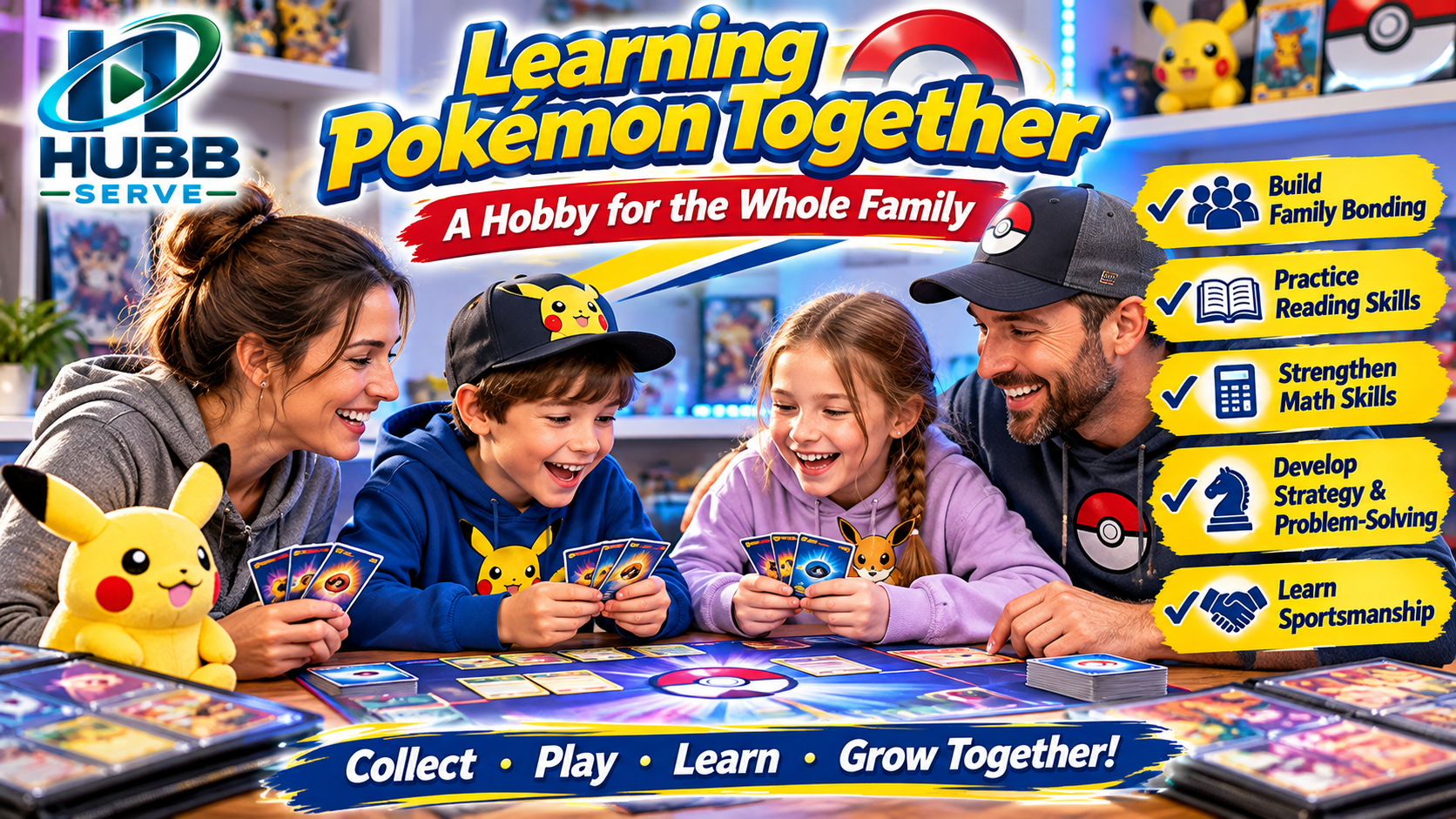
Pokémon isn't just a card game. It's an opportunity to spend time together, share interests, and build skills through play.
For parents and families, learning Pokémon together can create valuable experiences beyond the game itself.
Practice Reading and Comprehension
Reading Pokémon card descriptions and understanding attack instructions helps develop reading skills.
Build Math Skills
Players calculate damage, track HP, and determine how many Energy cards they need.
Develop Strategy and Problem-Solving
Every turn requires planning, decision-making, and thinking about possible outcomes.
Learn Sportsmanship
Winning gracefully, handling losses, taking turns, and respecting opponents are lessons that extend beyond the game.
Encourage Family Bonding
A friendly Pokémon battle can turn an ordinary afternoon into family game night.
You don't have to know everything about Pokémon to enjoy it together. Sometimes learning alongside your child is the best part of the adventure.
9. Practice Pokémon Online
Want to practice before battling someone in person?
Pokémon TCG Live offers a digital way to learn and play the trading card game, with guided learning opportunities and automated rule enforcement.
It's a useful resource for players who want to understand turn sequences, attacks, and different strategies.
Parents should review age requirements, account settings, and online interaction features before allowing children to participate.
Visit the official Pokémon website to learn more about Pokémon TCG Live and available beginner resources.
10. Ready to Take Your Pokémon Skills to the Next Level?
Once you've mastered the basics, there are plenty of ways to continue your Pokémon journey!
Try a different preconstructed deck.
Build a strategy around your favorite Pokémon.
Learn about Pokémon types, Weakness, and Resistance.
Explore new Pokémon card sets.
Organize your collection in a binder.
Play friendly matches with family and friends.
Explore local Pokémon League events with appropriate adult supervision.
Remember, you don't need the rarest or most expensive cards to have fun.
The best Pokémon adventure starts with curiosity, grows through practice, and becomes even better when shared with others.
Gear Up for Your Next Pokémon Battle!
Ready to go from collecting cards to mastering the game?
Discover Pokémon Battle Decks, beginner learning kits, playmats, card sleeves, deck boxes, damage counters, and accessories to help make every battle more exciting.
Whether you're learning to play, building your first deck, or planning a Pokémon family game night, find the gear to start your next adventure!
SHOP POKÉMON CARDS & BATTLE GEAR
Affiliate Disclosure: Some links may be affiliate links. Hubb Serve may earn a commission from qualifying purchases at no additional cost to you.
Keep Exploring Pokémon Hubb!
Your Pokémon journey doesn't stop after your first battle.
Explore collecting guides, card types, accessories, games, and more right here on Pokémon Hubb.
Discover. Collect. Trade. Play. Your Pokémon Adventure Starts at Hubb Serve!
Pokémon Hubb is an independent informational resource and is not affiliated with or endorsed by The Pokémon Company, Nintendo, Game Freak, or Creatures.